Dairy cow AIoT software
Content
1. Group Center
Establish a group organizational structure to meet the management needs of each farm within the group, and enable direct system adjustments when there are changes in the group's leadership, thereby enhancing data security and information confidentiality within the system.
By establishing and improving the group center, the overall management of the group and the management status of each ranch have been strengthened, directly enhancing the management level and reducing communication costs.
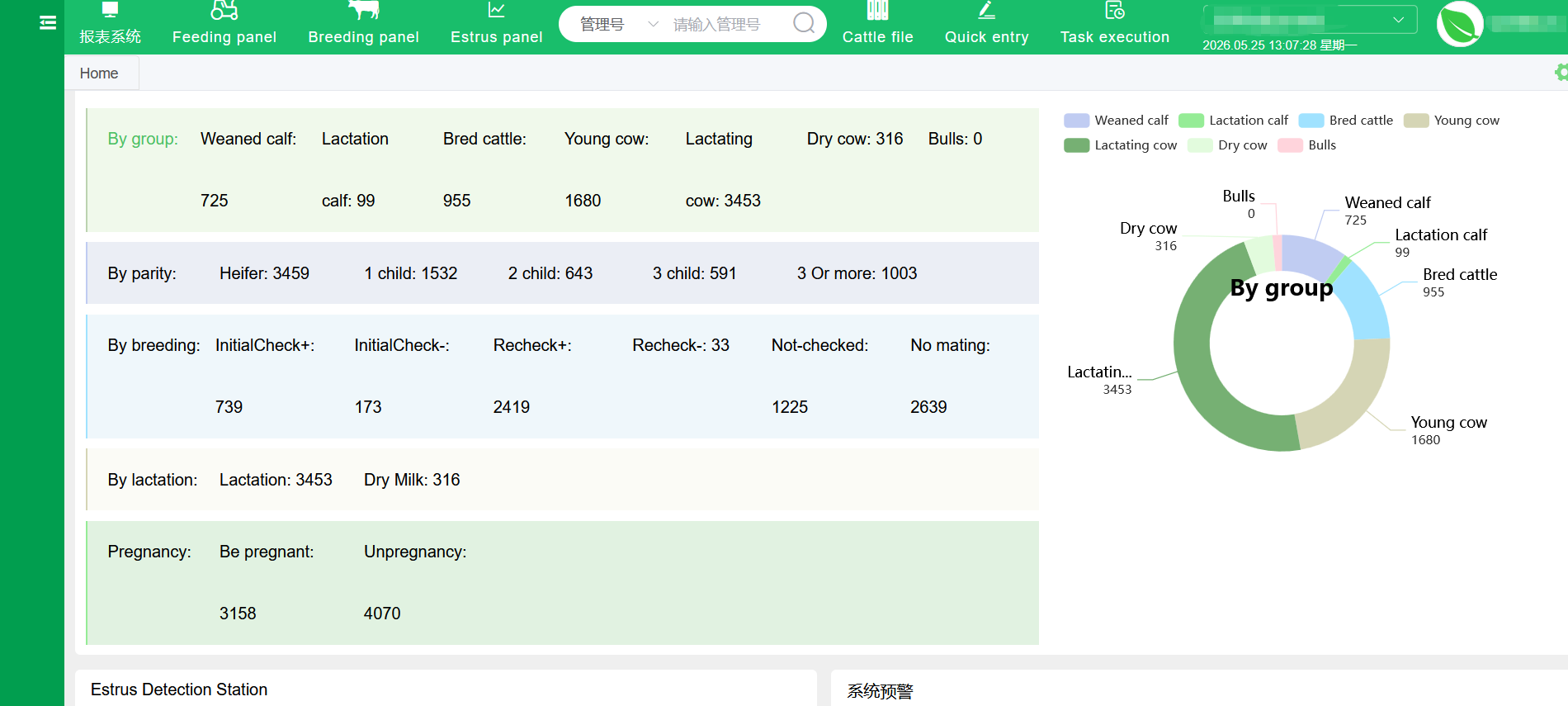
After logging into the platform, team leaders will first see the management dashboard, which lists the key indicators and important information of the farms under their jurisdiction, including total milk production, unit yield, and a K-line chart showing changes in unit yield. This enables managers to understand the operational status of the farms for the first time.
2. Basic data
Establish databases for warehouse information, feed information, drug information, diseases, vehicle information, employee information, buyer and seller profiles, frozen semen information, consumables information, and spare parts information, providing basic documents and information for TMR precision feeding, epidemic prevention and diagnosis, cow estrus monitoring, breeding, and other aspects. By establishing basic data, the inventory, feed, and drug usage of each ranch can also be organized, ultimately completing the cost and consumption statistics for each link, thereby calculating the actual costs and benefits of the ranch.
3. Basic records of cattle
Establish information on cattle sheds, grouping information, definitions of growth cycles, cattle herd archives, and pedigree relationship diagrams for cattle, thereby improving multiple key cattle herd data such as inventory, cattle inflow and outflow, grouping, pen adjustments, and pedigree status, providing the most accurate inventory and cattle status for ranch managers. By improving basic cattle herd archives, it not only promotes the management of cattle on the ranch but also facilitates the management of the current status of cattle sheds and cattle herds by managers.
4. TMR precision feeding
Establish formula information, feeding group information, and feeding table information for each ranch. Once the information is confirmed, feed mixing and feeding tasks will be directly issued to the feed operators through TMR vehicles and forklift tablets. Through the tablet, operators can view the addition sequence and weight of each feed in the current formula. Through the material identification function, the TMR precision feeding system records the actual feeding and mixing status of the feeding operator. Through the barn identification function, the system can record the actual feeding uniformity of the feeding operator. The system will directly upload the actual feeding conditions and ultimately generate multiple charts, such as the overall feeding curve.
The TMR precision feeding system enables managers to have a comprehensive understanding of the status of each mixing and feeding process. By analyzing the milk yield of cows, it can identify any issues in the feeding process and provide data support for the performance evaluation of feeding operators.
5. Management of dairy hall
Milk room management primarily obtains milking data through two methods. The first method involves integrating the interfaces of most mainstream brands of milking machines to directly acquire milking data (requiring the cooperation of milking equipment manufacturers to provide interfaces). The second method involves manual import.
The milk depot management system enables managers to understand the milk production status of each shift of cows. When issues arise, the system quickly identifies the problem through trend charts and arranges for timely handling, greatly avoiding greater losses and thereby enhancing the direct profits of the farm.
6. Reproduction management
By timely managing estrus, breeding, initial examination, re-examination, abortion, parturition, weaning, and dry periods, the reproductive rate, estrus detection rate, and herd growth of cattle are significantly improved. This, in turn, maximizes the milk production of the farm and enhances the reproductive efficiency of the herd.
Through the estrus monitoring system, breeders can obtain information on feed intake and exercise levels of cows anytime and anywhere. When there are abnormalities in feed intake and exercise levels, the system will promptly notify breeders of potential diseases or estrus, greatly reducing their workload and enhancing the immediacy of event handling.
Estrus synchronization, selection of cattle for estrus synchronization, estrus investigation, etc.
Material Management
Material management effectively monitors the material status of the ranch by managing the inflow, outflow, and return of feed, drugs, spare parts, and other inventory. It also provides accurate inventory and location information, facilitating efficient material management and inventory inspection. The system is equipped with alert functions, such as maximum inventory and safety stock, enabling timely procurement of various materials. Purchasing includes purchase orders and quality inspection forms, and important materials can also be labeled with identifiable material tags. Shipping, especially material supply, can automatically generate shipping orders based on TMR mixing data, eliminating the need for manual operations. Important materials can be displayed based on their tags. Inventory inspection mainly relies on inventory inspection forms, and the system automatically generates inventory loss and inventory gain data, facilitating material management for managers. Cost accounting involves creating unit price settlement forms, maintaining material unit prices, and implementing daily cost accounting for materials.
8. Automatic weighing and grouping management
The automatic weighing and grouping software system automatically measures the weight, body length, and diagonal body length of each cow, significantly reducing the manpower and time required for daily measurement work on the farm. This not only improves measurement efficiency but also ensures accurate and timely data upload. Based on the physical condition of each cow, targeted grouping is carried out to accurately understand the growth status of each cow on the farm. Managers can utilize the statistical data on cow growth to group and feed cows that have not yet reached a specific physical condition. By effectively improving the healthy growth of cows, the economic benefits of the farm are indirectly enhanced.
9. Veterinary management
Veterinary management primarily involves recording events such as disease occurrence, medication administration, and cow recovery. Furthermore, it encompasses routine management of recurrent disease events in cows, including hormone therapy, postpartum monitoring and care, health maintenance, isolation, immunization, hoof trimming, management of non-lactating areas and recovery, as well as dehorning. This aids managers in timely understanding of the herd's condition and prompt adjustments to the herd structure. On one hand, veterinary management documents inherent events in the herd's lifecycle, such as isolation, immunization, and postpartum care. On the other hand, it emphasizes the management of occasional diseases in cows, thereby establishing a comprehensive disease management process. This process aims to reduce the culling and mortality rates of cows, significantly lower the cost of dairy farming, and enhance the economic benefits of farms.
10. Environmental monitoring
The environmental control module automatically collects sensor data from various areas of the ranch, including temperature, humidity, ammonia, carbon dioxide, and hydrogen sulfide, at fixed intervals. This enables real-time monitoring of the environmental conditions in each area of the ranch, allowing for effective handling of anomalies and preventing losses caused by environmental issues. Through the environmental data statistics module, managers can conduct effective data analysis based on time and monitoring type, and combine it with the actual condition of the cattle to identify potential environmental issues on the ranch. This, in turn, enhances the comfort of the cattle and improves the economic efficiency of the ranch.
11. Feeding and management module
The primary focus of breeding is on the production evaluation of cattle, as well as daily basic management, such as cattle entry, pen adjustment, transfer, culling, death, changes in cattle numbers, and herd fluctuations. In addition, the introduction of physical and chemical indicators constitutes the basic data of the ranch.
12. Breeding management
Carry out body type identification and registration, cattle breed pedigree registration, as well as record the production performance and body type breeding value of cows, laying the foundation for scientific breeding.
13. Establish a workstation
The system establishes different workstations based on different roles, centrally displaying key information that each role is concerned about, ensuring convenience and ease of use for all users. When different roles log in to the system, the first thing the system displays is their unique workstation.
14. Intelligent early warning
The system is equipped with various warning parameters to achieve automatic logical judgment, timely reminders, prompt follow-up, and evaluation, ensuring a scientific breeding process. For example, early birth warning, weaning warning, initial mating warning, early pregnancy test warning, breeding prohibition warning, dry milk warning, estrus monitoring warning, safe inventory warning, and out-of-stock load rate TC
15. Logic check
Conduct data verification and logical judgment within the system, and immediately issue an alert for any logically incorrect data, such as a cow in Class 16
During this period, milk was produced only once. Event inquiry report
By summarizing daily events, you can query the total number of events within a selected time interval as well as detailed information for each event.
17. DHI
"DHI report download, comprehensive early warning, and other functions"
18. Comprehensive statistical analysis
All data related to various aspects of agriculture are stored in the platform, and the system is equipped with some daily use reports, such as the cost per kilogram of milk, inventory ledgers, disease record sheets, feeding efficiency analysis reports, and overall herd profiles. In addition, the platform also features a customized query function, allowing managers to build customized query reports according to their management needs. This is convenient, fast, efficient, and practical. In short, data is the foundation of management. Through big data analysis methods such as data mining, decomposition, integration, and reorganization, the digitalization and precision of the agricultural process on the ranch can be achieved.
19. Self-service settings
The system primarily involves setting system parameters, disease treatment procedures, and disease customization. Users can customize these settings according to their specific farming conditions to ensure data accuracy. Parameter settings mainly involve customizing parameters based on the growth cycle of cattle. The disease treatment procedures follow the process control standard prescriptions established by the team. For custom diseases, users can define diseases that do not exist in the standard disease database of the group.
20. Task list
In the SOP process, design relevant task trigger parameters. The system will generate a production task list based on the steps set in the SOP process and push the relevant task list to the corresponding employees according to the SOP type. The system can also automatically generate weekly task lists for employees, assign work tasks to farm employees, and guide them to work according to the SOP process. View the completion progress of the weekly task list content and check the to-do items.
21. Performance evaluation
Based on the relevant data in the system, such as solidification rate, elimination rate, reproduction rate, conception rate, and yield per unit, these indicators are correlated with the performance of each position, and the evaluation is based on the completion status.
22. Interface management
Capable of integrating data with current mainstream smart agricultural equipment, including DeLaval, Afimilk, GEA, etc.; TMR and precision feeding systems from companies such as Tulip and Start; estrus monitoring devices from Afimilk, etc.; automatic calf feeding systems from O'Brien; environmental monitoring systems; automatic weighing and sorting systems; Jindi financial systems; GPS systems for milk delivery vehicles, etc.
23. Mobile information management
The system not only supports operations on the PC side but also on the APP side. The main functions of the APP include system alerts, related event entry, and a comprehensive sensitive management data dashboard. For frontline employees at the ranch, the APP is primarily used to handle current to-do items, system alerts, and related event entries, enabling them to enter data in real-time and improving data accuracy and timeliness. For managers, the APP is mainly used to view management data, such as herd structure, single yield, daily yield observations, and indicator analysis.
24. Management evaluation indicators
The system possesses comprehensive and complete management evaluation indicator data, which meets industry standards. It can be benchmarked against domestic big data or customized according to actual situations.
25. System management
The main system backend data, permissions, and security management encompass platform user grouping, organizational structure, organizational hierarchy, relationships between farms and organizational structure, user and role binding, functional roles, permission settings, mobile login binding, daily data backup and recovery, system events, login, detailed records of data operations (addition, deletion, modification, and query), sub-definition projects, as well as data statistics methods and scope. User security and logs primarily include system password modification, organizational structure maintenance, custom roles, farm information management, user maintenance, user approval, and system deployment, which involves deploying system applications, data, and files to the server room of the group headquarters. Each farm accesses the system through account login.


| Phone : | +86 10 56299299 |
|---|---|
| Email : | info@gokeagri.com |
| Wechat : | gokeagri |
| Site : | www.gokeagri.com |
| Address : | Building 28, Max Teda Technology Park,Shunyi District,Beijing |